
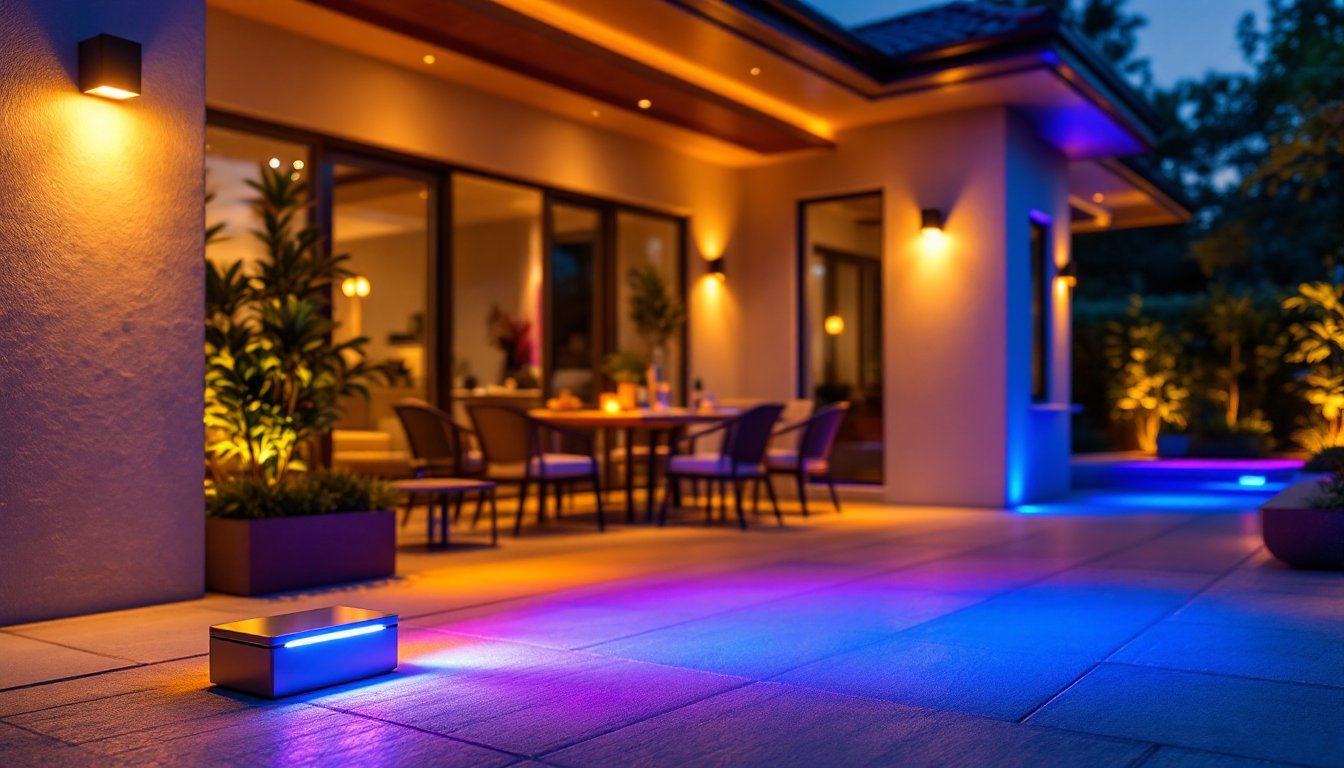

Color-changing outdoor recessed lighting has moved from luxury resort amenity to practical DIY upgrade. Unlike fixed white bulbs, RGB (red-green-blue) outdoor recessed lights let homeowners dial in mood lighting, enhance security, or match seasonal themes without running new wiring or calling an electrician. The technology is more accessible, and affordable, than ever. Whether someone wants to host an evening gathering with ambient blues and purples or brighten the patio for a late-night barbecue, these lights adapt. This guide breaks down the systems available, what to expect during installation, and which setup makes sense for different patios and skill levels.
Key Takeaways
- Color-changing outdoor recessed lighting uses RGB LED technology to produce thousands of color combinations, offering flexibility for ambiance, security, and task lighting without rewiring.
- Smart Wi-Fi systems provide app-based control and scheduling ($150–$400 per fixture), while manual remote options offer simplicity and reliability at lower cost ($80–$200 per fixture).
- LED fixtures consume 75–80% less electricity than traditional bulbs and last 25,000–50,000 hours, reducing utility bills and replacement frequency over roughly 10–15 years of use.
- Installation varies: swapping existing recessed fixtures is straightforward, but new installations require proper weathertight housing, UV-rated wiring, and verification of local electrical codes.
- Outdoor recessed color-changing lights enhance curb appeal and property value while providing enhanced security when integrated with motion sensors or scheduling features.
- Maintenance requires twice-yearly inspections for debris and corrosion, re-caulking every 2–3 years, and annual battery replacements for wireless remotes to ensure longevity.
What Is Color-Changing Outdoor Recessed Lighting?
Color-changing outdoor recessed lights are fixtures that mount flush into soffits, deck fascia, or ground surfaces and emit adjustable colors instead of one fixed white temperature. The core technology is LED (light-emitting diode) chips that blend red, green, and blue wavelengths in varying intensities to produce thousands of color combinations.
These lights sit in an outdoor-rated housing, typically aluminum or stainless steel, with an IP rating of IP65 or IP67 to withstand rain and moisture. The fixture connects to a power supply and a control system (either wireless or wired). Unlike traditional recessed lights, color-changing systems require a bit more infrastructure: a controller unit (often mounted indoors), compatible wiring, and sometimes a smartphone app or remote.
The appeal is flexibility. A homeowner can set warm amber for evening relaxation, shift to cool white for cooking and cleaning, or program a slow color fade for ambiance. Some systems even sync with music or respond to voice commands if integrated with smart home platforms.
Key Benefits of RGB Outdoor Recessed Lights
Mood and ambiance is the obvious draw. Warm tones (reds, oranges) promote relaxation for lounging or dinner parties. Cool whites improve visibility and readability for tasks like grilling or reading. Homeowners who entertain frequently appreciate the ability to adjust the vibe without touching a single switch, just pull out a phone or press a remote.
Enhanced security is an overlooked advantage. A well-lit patio in bright white deters unwanted visitors. Some systems can flash or change colors if motion sensors trigger them, adding a visual deterrent at night.
Energy efficiency matters on the wallet. LED lights consume 75–80% less electricity than incandescent or halogen recessed lights and last 25,000–50,000 hours, roughly 10 years of typical residential use. This means fewer bulb replacements and lower utility bills, especially if the lights stay on for extended periods during outdoor entertaining season.
Curb appeal and property value are subtler benefits. A thoughtfully lit patio with color-changing accents feels intentional and upscale. Potential buyers often notice quality outdoor lighting when touring homes.
Types of Color-Changing Systems
Smart LED Recessed Lights
Smart (Wi-Fi or Bluetooth) systems offer the most control and convenience. A homeowner installs a central controller indoors, often a compact hub plugged into a standard outlet, and pairs it wirelessly with a set of outdoor LED recessed fixtures. Control is via smartphone app, voice assistant (Alexa, Google Home), or physical remote.
Advantages include scheduling (set lights to turn on at sunset and fade to a certain color), color looping (slow, continuous shifts), and integration with other smart home devices. Disadvantages: require a stable Wi-Fi signal (outdoor fixtures must be in range), initial setup can feel technical, and if the hub fails, the lights revert to a single default state until the system reboots.
Costs range from $150–$400 per light fixture for mid-range smart systems, plus $80–$150 for the controller hub. Premium brands with robust ecosystems (extensive color presets, scene creation, voice control) run higher.
Manual Control Options
Wired remote control systems skip Wi-Fi entirely. A wireless remote (usually battery-powered) sends a signal to a receiver wired to the lights. No app, no internet dependency, and faster response times. Setup is straightforward: run low-voltage wiring from the receiver to each fixture (or connect fixtures in parallel), and the remote works up to about 50 feet away.
Trade-offs: limited color memory, no scheduling, and the remote can get lost or damaged. These systems suit homeowners who want simplicity and reliability over feature richness, perfect for a small deck with two or three lights.
Costs are lower: $80–$200 per light, plus $50–$100 for a compatible remote receiver. No hub needed.
Installation and Compatibility Considerations
Installation difficulty depends on whether recessed housing already exists. If cut into existing soffits or deck fascia, swap-out is straightforward: turn off power, unscrew the old fixture, and install the new one in the same rough opening. The catch is ensuring the new fixture’s power requirements and controller compatibility match.
Electrical considerations: Most outdoor recessed lights run on 12V or 24V low-voltage systems, supplied by a transformer stepped down from standard 120V household power. A few premium systems use 120V directly. Check the product spec before purchase: mismatched voltage means the lights won’t function or could fail prematurely.
For new installations (cutting into soffits for the first time), measure twice, mark centers carefully, and use a reciprocating saw or hole saw to cut openings slightly larger than the fixture’s trim ring. Fiberglass-insulated rough-in cans (available at home centers) provide a weathertight housing that bridges from the outdoors to indoor wiring. Seal around the trim ring with exterior-grade caulk to prevent water infiltration.
Wiring runs should use UV-rated, outdoor-rated cable (often labeled as UF or USE cable). Bury it at least 6–12 inches below grade if running ground-level fixtures, or run it inside conduit along the fascia. Local building codes vary: some jurisdictions require a licensed electrician for low-voltage outdoor work. Check your municipal code before starting.
Compatibility with existing systems: If there’s an existing outdoor lighting circuit or controller, confirm voltage and wireless frequency (Bluetooth, 2.4 GHz Wi-Fi, proprietary 433 MHz, etc.) before buying. Mixing brands rarely works cleanly.
Maintenance and Longevity
LED fixtures are largely maintenance-free, but outdoor exposure demands attention. Inspect trimrings and seals twice yearly, spring and fall, for debris, corrosion, or water stains. If debris accumulates, gently brush it away with a soft cloth: never use high-pressure washers directly on fixtures.
Weathering and corrosion happen slowly on aluminum or stainless steel, but salt spray (near coastal areas) and extreme UV can degrade caulk around the trim. Re-caulk every 2–3 years with polyurethane or silicone sealant rated for exterior use. This prevents water ingress, which shortens the lifespan of electronics inside the fixture.
Controller and remote battery maintenance: Smart hub controllers should be kept indoors in a climate-controlled space. Wireless remotes use AA or AAA batteries: replace them annually or when responsiveness slows. Pair fresh batteries with the receiver according to the manual.
Expected lifespan: A quality outdoor recessed LED fixture lasts 25,000–50,000 hours, typically 10–15 years of outdoor residential use (assuming 4–6 hours on per day). Controllers and remotes may need replacement or repair after 5–7 years, but the main fixture often outlasts the rest of the system. When a fixture finally fails, most are not serviceable: they’re replaced as a unit. Fortunately, prices have dropped, and replacements are a straightforward swap.