
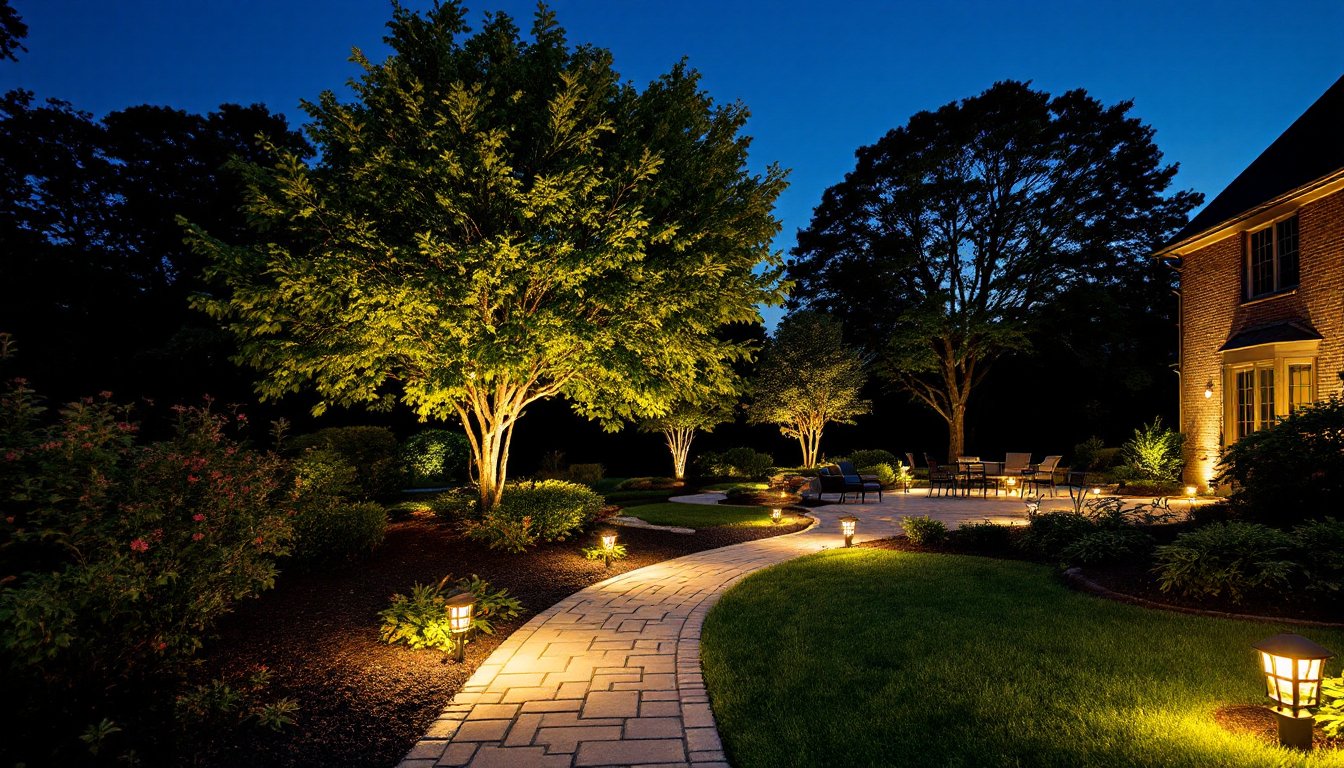

Landscape lighting transforms a Cincinnati yard from invisible after sunset into a welcoming outdoor space that extends your home’s usable hours. Beyond aesthetics, outdoor lighting improves safety by illuminating walkways and driveways, deters intruders, and highlights landscaping investments. Cincinnati’s humid summers and snowy winters demand fixtures and designs suited to regional weather, selecting the right setup isn’t a minor detail. Whether planning a new installation or upgrading existing lights, understanding landscape lighting fundamentals helps homeowners make informed decisions and budget accordingly. This guide walks through types, design principles, energy efficiency, and when to hire a professional.
Key Takeaways
- Landscape lighting in Cincinnati enhances safety, property value, and curb appeal while accounting for the region’s humid summers, cold winters, and freeze-thaw cycles that demand durable, weather-resistant fixtures.
- Path and accent lighting serve distinct purposes: path lights guide foot traffic at 3–5 watts, while accent lighting with 30–60 degree beam angles highlights landscaping features from 3–5 feet away.
- LED landscape lighting saves 75–85% energy compared to halogen, lasts 25,000+ hours versus 2,000–4,000 hours, and reduces replacement costs by $200–400 over five years.
- Proper planning requires sketching focal points, burying low-voltage wiring 6–8 inches deep in trenches, and accounting for seasonal changes like deciduous trees and winter snow cover that affect light placement.
- Professional landscape lighting installation costs $1,500–5,000 for mid-sized projects and ensures code compliance, proper grounding, and prevents safety hazards—worth considering for complex designs beyond simple DIY path-light kits.
Why Landscape Lighting Matters for Cincinnati Homes
Cincinnati’s climate, with humid summers, cold winters, and occasional ice, creates distinct lighting challenges. Fixtures exposed to moisture and temperature swings need durable construction: cheap plastic housings fail within a season. Beyond durability, landscape lighting serves practical and market-driven purposes. A well-lit front entrance improves curb appeal and signals security to potential buyers or visitors. Backyard accent lighting highlights mature trees, garden features, and patios, making outdoor entertaining more enjoyable. Path lighting along walkways and driveways prevents trips and liability issues, especially important if clients or family visit your home. Insurance providers sometimes offer discounts for homes with functional outdoor security lighting. The investment typically pays for itself in safety, property value, and usability.
Essential Types of Landscape Lighting for Your Property
Path and Accent Lighting
Path lights are low-voltage fixtures, usually 6–18 inches tall, positioned along walkways, stairs, and driveways. They guide foot traffic safely and consume minimal power (typically 3–5 watts per bulb). Stake or bollard-style fixtures anchor directly into soil or planting beds: because Cincinnati’s clay soils and freeze-thaw cycles can heave ground-mounted fixtures, secure anchors and periodic leveling prevent tilting. Accent lighting uses smaller spotlights or spotlights mounted on walls or stakes to illuminate plants, statuary, or architectural features. A 60-degree beam angle works well for shrubs and small trees: narrower 30-degree angles target focal points like specimen plants or water features. These fixtures should be positioned 3–5 feet from the plant or object to avoid harsh shadows.
Uplighting and Spotlights
Uplighting places a light source at ground level pointing upward to silhouette or highlight tall trees and building facades. This technique creates drama and depth in a nighttime landscape. Spotlights, mounted higher on posts or structures, cast light downward or at an angle to illuminate broad areas or distant features. Both uplighting and spotlights run on low-voltage systems (12V standard) and come in halogen, LED, and increasingly efficient variants. LED uplights and spotlights produce the same brightness as older halogen units while using 75–85% less energy and lasting 25,000+ hours versus 2,000–4,000 hours for halogen.
Designing a Lighting Plan for Cincinnati’s Climate and Terrain
Cincinnati neighborhoods vary dramatically, from flat urban lots to sloped suburban properties. Before buying fixtures, sketch your yard and identify focal points: mature trees, architectural features, seating areas, and high-traffic paths. Measure distances from the proposed light source to targets: this determines fixture wattage and beam angle. Cincinnati clay soils drain slowly, so bury low-voltage wiring in trenches at least 6–8 inches deep, running it away from downspouts and areas prone to pooling. Protect wiring with conduit in high-foot-traffic zones. Consider seasonal changes: deciduous trees lose leaves in fall, altering how light reflects and casts shadows. Plan for growth, young trees will block uplighting as they mature. Winter snow cover affects path lights: fixtures that sit low may be buried after a heavy snowfall, requiring taller stake-style lights in areas prone to accumulation. Test light placement during evening hours before finalizing installation: what looks good in daylight sketches may feel too bright or dim in practice.
Energy-Efficient LED Options and Cost Savings
LED landscape lighting has become the practical choice for Cincinnati homeowners. An LED low-voltage system uses a transformer (typically 60–150W depending on fixture count) plugged into a standard outdoor GFCI outlet, converting household current to 12V for landscape fixtures. LED bulbs for landscape use come in warm white (2700–3000K) or cool white (4000–5000K): warm white suits residential settings and creates inviting ambiance, while cool white works better for security and task lighting. Comparing costs: a typical outdoor LED path light costs $15–40, while a halogen equivalent runs $10–25 but burns out in 2–4 years and costs more to replace. Over five years, switching to LED saves $200–400 in bulb replacements alone, plus reduced transformer draw and electricity. Low-voltage LED systems also run cool enough to touch during operation, reducing fire risk near plants or structures. Look for fixtures rated IP65 or higher for water resistance, Cincinnati’s humidity and spring thaw demand robust sealing. Some LED fixtures include integrated smart controls, allowing dimming or scheduling via a smartphone app, though this adds 20–40% to upfront cost.
Choosing the Right Landscape Lighting Professional
DIY landscape lighting is achievable for simple path-light installations: buy a kit, run low-voltage wiring, stake fixtures, and plug in the transformer. But, larger designs involving uplighting, multiple circuits, or integration with smart home systems benefit from professional planning. A qualified landscape lighting designer or electrician evaluates your yard’s layout, assesses transformer capacity, codes compliance, and ensures proper grounding and wire sizing. In Cincinnati, outdoor low-voltage work typically doesn’t require a permit if the transformer uses standard household 120V power, but check with your city, some jurisdictions require licensed electrician sign-off for outdoor wiring. If your design includes line-voltage fixtures (standard 120V outdoor lights rather than low-voltage), a licensed electrician is mandatory: improper installation creates shock and fire hazards. When hiring, request references from recent Cincinnati-area projects, verify insurance, and ask about warranty on installation labor. A professional typically charges $1,500–5,000 for a mid-sized residential design and installation, depending on fixture count and complexity. While not cheap, professional installation ensures code compliance, correct wire sizing, and proper grounding, details that prevent costly failures or safety issues down the line.